
What is keymitt
keymitt lets AI agents use your credentials without the credential values ever entering the agent's context. It is an MCP server plus a command-line tool, and it runs on your own machine.
The problem
Sooner or later an agent's task needs a credential: an API token, a database password, a deploy key. Today there are three options, and none of them is good:
| Option | What goes wrong |
|---|---|
| Paste it into the chat | It now lives in the transcript, forever, wherever transcripts go. |
| Put it in a file the agent can read | The agent reads it — and quotes it back in a summary or a log. |
| Do that step yourself | You become the agent's hands, and the automation stops being automatic. |
keymitt is a fourth option: the agent uses the secret by name, and never sees its value.
How it works
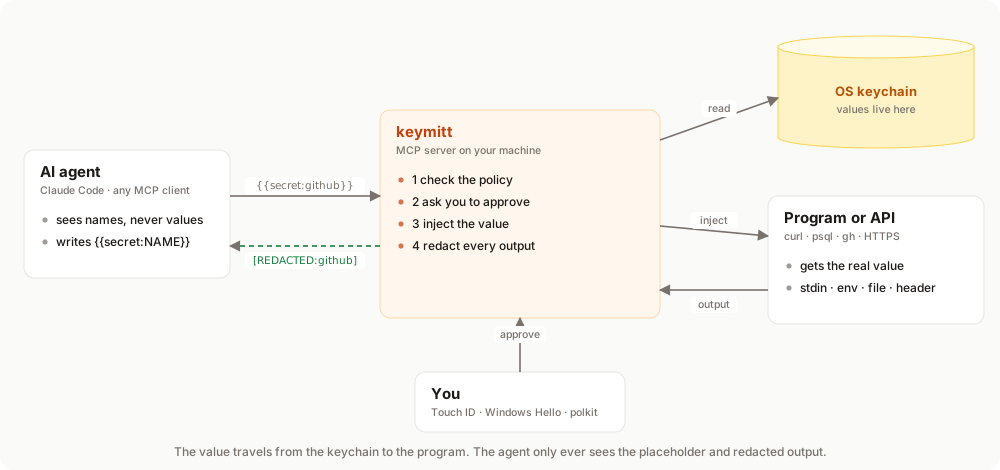
- The agent writes a placeholder such as
{{secret:github}}in a request — in a header, in text for a program's stdin, in an environment variable or in a temporary file. - keymitt checks the policy: may this secret go to this program, or to this host?
- keymitt asks you to approve the exact request, with Touch ID or your password on macOS, Windows Hello on Windows, or polkit on Linux.
- keymitt reads the value from the OS keychain and substitutes it at the last moment.
- Everything that comes back — stdout, stderr, response headers and body — is redacted before the agent sees it.
What the agent can do
keymitt exposes five tools:
| Tool | Purpose |
|---|---|
list_secrets | What secrets exist and how each may be used — never values |
run_with_secrets | Run a program with secrets in stdin, env or temp files |
http_request | Let keymitt send an HTTP request to an allowed host |
read_file_redacted | Read a config file with credentials masked |
request_secret | Ask you to store a secret it needs, with a ready-made command |
There is deliberately no tool that returns a value, exports secrets or changes the policy.
Redaction
Before anything is returned to the agent, keymitt replaces the values of all registered secrets — not only those used in the request — with [REDACTED:NAME]. It also catches the forms a value takes most often in output: base64 (at any alignment inside a larger blob), URL encoding, hex and JSON escaping. Redaction happens before output is truncated, so a value sitting on the cut cannot leak half of itself.
read_file_redacted adds a second layer for config files: anything that looks like a password, token, private key or a password inside a connection string is masked too.
What keymitt is not
keymitt prevents accidental exposure and makes every use of a secret visible and approved. It is not a sandbox against an agent that is deliberately malicious and can run any command as your user. The security model spells out the difference.